

Your blood test report has just arrived. You open it and find some values are slightly above the laboratory’s reference range. You may be left wondering whether everything is still normal or something is wrong.
A high or low number outside the printed range is worth your attention, but it doesn’t tell you what underlying condition may have caused it or whether you need further tests. Knowing how to read and interpret your blood test report can help you avoid undue anxiety and prepare for a useful conversation with your GP.
Understanding your blood test report
In most blood test reports, you’ll see a table with four or five labels: test name, result, unit of measurement and reference range. The test name is the name of the test performed. The result column gives the actual value found during the test, while the unit tells you how the number is expressed.
The reference range usually represents the range of values found in most individuals from a defined reference population, generally people considered healthy. It’s also the range against which you can compare your result. Some reports highlight values in bold, or with an H for high or L for low, when they fall outside the laboratory’s range.
Below is an example fasting plasma glucose test report. The reference interval comes from the Royal Melbourne Hospital. It is not a universal blood glucose target.
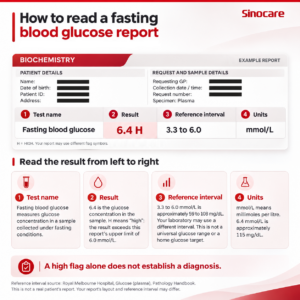
From the report above, you can see that the result (6.4 mmol/L) is above the reference range for fasting plasma glucose. But the report doesn’t explain why it is higher or whether treatment is needed.
Your GP will review your clinical history and decide whether further testing, such as an HbA1c or an oral glucose tolerance test, is needed. In non-pregnant adults, a fasting plasma glucose result of 6.4 mmol/L is considered impaired fasting glucose (IFG), which is commonly referred to as prediabetes. But the test alone does not diagnose diabetes.
Common blood test results explained
Use the infographic below to understand what each test measures and how to interpret it. It’s a starting point for reading your report, not a guide to diagnosing the cause of every abnormal result.
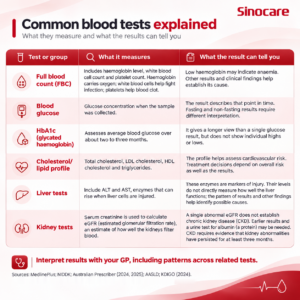
A normal haemoglobin level doesn’t rule out low iron levels. If your GP suspects iron deficiency, you may need additional tests. Similarly, it may take time to find out whether a kidney condition is chronic, but that doesn’t mean you can delay getting a new abnormal kidney test result checked.
What do high or low results mean?
A high or low result in a blood test report can have several causes. It can be due to an underlying condition or to the circumstances under which the sample was collected. For example, eating a meal before measuring your blood sugar can raise your plasma glucose level. So if you eat before a fasting glucose test, your result may be higher than it would have been if you had fasted.
The medicines you take can also influence results in different ways. Some directly change the levels being measured in the body, while others interfere with the measurement itself.
For example, corticosteroids such as prednisolone can raise your blood sugar levels by increasing glucose production and causing insulin resistance. High doses of biotin (vitamin B7) can interfere with certain thyroid blood tests and produce falsely high or low results by disrupting the biotin-streptavidin binding used in some laboratory immunoassays.
It’s also worth knowing that a result above or below the reference range doesn’t mean a person is seriously ill. Many healthy people have results outside the range, while someone whose results fall within it may still have unexplained symptoms.
Another factor that can lead to an unexpected result is a change in testing conditions. If you have previous test results, check whether they’re for the same test and use the same units. Then compare the reference ranges and the conditions under which the samples were collected. You may get the same blood glucose reading from a fasting test and one taken after a meal, but the result needs to be interpreted differently in each case.
Home Blood Glucose Monitoring
Laboratory plasma glucose tests and home blood sugar monitoring are not the same, and they serve different purposes. Lab tests help diagnose diabetes and track blood sugar over time. A home finger-prick meter lets you check your blood sugar throughout the day and stick to your individual care plan. But it can’t diagnose diabetes or replace laboratory glucose or HbA1c testing.
If you have type 1 or type 2 diabetes, your GP may recommend checking your blood sugar at home. Whether you need to test, and how often, depends on your treatment plan. Talk with your diabetes care team about when to test and what action to take. Keep a record of your readings, including whether you tested before or after meals, so your care team can interpret them in context.
One example of a home meter is the Sinocare Safe AQ Pro I, which stores up to 500 results with the date and time. It is for in vitro diagnostic use only, as an aid in monitoring glucose, and isn’t intended for diagnosing or screening for diabetes. Always read the label and follow the directions for use.
When to discuss your results with a healthcare professional
Ask your GP or care team about the result that concerns you and how it relates to your symptoms. For the example above, you could ask: “My fasting blood glucose result is above the reference interval. What does it mean for me? Do I have diabetes? Do I need any additional tests?”
Bring relevant previous reports too. Tell your GP about prescribed medicines, supplements, persistent symptoms and anything you started or changed between tests. Don’t stop or change prescribed medication based on your own interpretation of a report.
Before the conversation ends, confirm whether further testing is needed and when to follow up. If another test is planned, make sure you know how to prepare for it. Follow any urgent instructions you’ve been given about your results. Keep a note of the agreed next steps so you know what to do after your appointment.
Medical disclaimer: This article is for general education and does not replace individual medical advice. Discuss your results and treatment decisions with your GP or treating healthcare professional.
Editorial disclosure: This article was commissioned by Sinocare.
For more information:
- American Association for the Study of Liver Diseases: How to approach elevated liver enzymes?
- Australian Prescriber: Non-anaemic iron deficiency
- Australian Prescriber: Preparation for blood tests: what can go wrong before the sample reaches the lab
- Australian Prescriber: Managing hypercholesterolaemia
- Australian Prescriber: Blood glucose monitoring devices: current considerations
- Diabetes Therapy: Practical guide to glucocorticoid induced hyperglycaemia and diabetes
- Health Sciences Authority (Singapore): Biotin interference with thyroid function tests
- Healthdirect: Guide to blood testing
- KDIGO: KDIGO 2024 clinical practice guideline for the evaluation and management of chronic kidney disease
- MedlinePlus: How to understand your lab results
- MedlinePlus: Complete blood count (CBC)
- MedlinePlus: Fasting for a blood test
- National Institute of Diabetes and Digestive and Kidney Diseases: The A1C test & diabetes
- National Institute of Diabetes and Digestive and Kidney Diseases: Diabetes tests & diagnosis
- Pathology Tests Explained: Reference intervals explained
- RACGP and Diabetes Australia: Management of type 2 diabetes: a handbook for general practice
- Royal Melbourne Hospital: Glucose (plasma), Pathology Handbook
- Sinocare: Sinocare Safe AQ Pro I blood glucose meter